 Research Assistant, University of Minnesota
I am a fourth-year Ph.D. student in Electrical and Computer Engineering at the University of Minnesota, advised by Prof. Mehmet Akçakaya, where I develop AI models for solving challenging imaging problems. My work spans designing new learning frameworks for reconstructing, enhancing, and generating images across both natural and medical domains. My research has appeared at leading CV/AI venues such as NeurIPS, CVPR, ECCV and ICIP, including spotlight recognitions at NeurIPS and ICIP. I also have several pending U.S. patents, have reviewed for top CV/AI conferences and journals, and have been a teaching assistant for courses on image processing and generative AI.
My current research interests include: generative modeling, inverse problems, text-to-image generation, and fast MRI reconstruction.
Warning
Problem: The current name of your GitHub Pages repository ("Solution: Please consider renaming the repository to "
http://".
However, if the current repository name is intended, you can ignore this message by removing "{% include widgets/debug_repo_name.html %}" in index.html.
Action required
Problem: The current root path of this site is "baseurl ("_config.yml.
Solution: Please set the
baseurl in _config.yml to "Education
-
University of MinnesotaPh.D., Electrical and Computer Engineering
Major: Electrical Engineering, Minor: Computer ScienceAug. 2022 - present -
 Istanbul Technical UniversityB.S., Electronics and Communication EngineeringAug. 2017 - Jun. 2022
Honors & Awards
-
Best paper finalist at IEEE CAMSAP2025
-
Spotlight at NeurIPS2025
-
Spotlight Oral at ICIP (“top papers with exceptional maturity and/or novelty”)2025
-
Summa Cum Laude merit award at ISMRM 2025 (abstracts score in the top 5%)2025
-
ECE Department Fellowship, University of Minnesota2022
News
Selected Publications (view all )
PnP-CM: Consistency Models as Plug-and-Play Priors for Inverse Problems
Yasar Utku Alcalar*, Merve Gulle*, Junno Yun*, Mehmet Akcakaya (* equal contribution)
IEEE/CVF Conference on Computer Vision and Pattern Recognition (CVPR) 2026
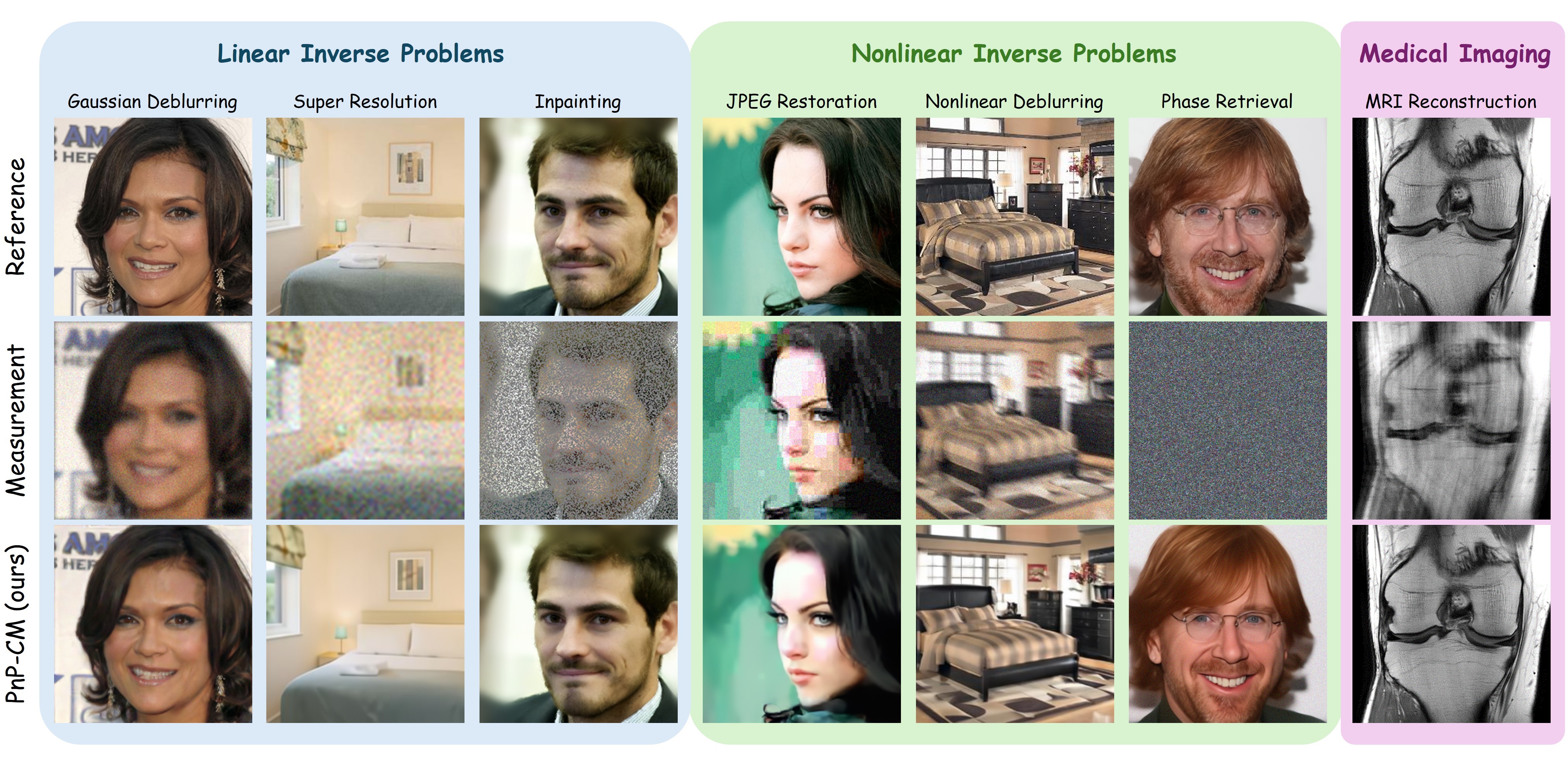
We propose PnP-CM, a plug-and-play solver that reinterprets consistency models (CMs) as proximal operators of a learned prior, enabling their seamless integration into plug-and-play (PnP) frameworks. Specifically, PnP-CM is an ADMM-based PnP solver that provides a unified approach to solving a wide range of inverse problems. This is, to the best of our knowledge, the first work to combine consistency models with plug-and-play methods. By incorporating noise perturbations and momentum-based updates, our method is particularly effective in the low-NFE regime. We evaluate PnP-CM on a range of linear and nonlinear inverse problems, including inpainting, super-resolution, Gaussian and nonlinear deblurring, phase retrieval, JPEG restoration, and MRI reconstruction, including the first CM trained on MRI datasets. PnP-CM achieves high-quality reconstructions in as few as 4 NFEs and produces meaningful results in just 2 steps, outperforming existing CM-based solvers.
PnP-CM: Consistency Models as Plug-and-Play Priors for Inverse Problems
Yasar Utku Alcalar*, Merve Gulle*, Junno Yun*, Mehmet Akcakaya (* equal contribution)
IEEE/CVF Conference on Computer Vision and Pattern Recognition (CVPR) 2026
We propose PnP-CM, a plug-and-play solver that reinterprets consistency models (CMs) as proximal operators of a learned prior, enabling their seamless integration into plug-and-play (PnP) frameworks. Specifically, PnP-CM is an ADMM-based PnP solver that provides a unified approach to solving a wide range of inverse problems. This is, to the best of our knowledge, the first work to combine consistency models with plug-and-play methods. By incorporating noise perturbations and momentum-based updates, our method is particularly effective in the low-NFE regime. We evaluate PnP-CM on a range of linear and nonlinear inverse problems, including inpainting, super-resolution, Gaussian and nonlinear deblurring, phase retrieval, JPEG restoration, and MRI reconstruction, including the first CM trained on MRI datasets. PnP-CM achieves high-quality reconstructions in as few as 4 NFEs and produces meaningful results in just 2 steps, outperforming existing CM-based solvers.
Fast MRI for All: Bridging Access Gaps by Training without Raw Data
Yasar Utku Alcalar, Merve Gulle, Mehmet Akcakaya
Neural Information Processing Systems (NeurIPS) 2025 Spotlight
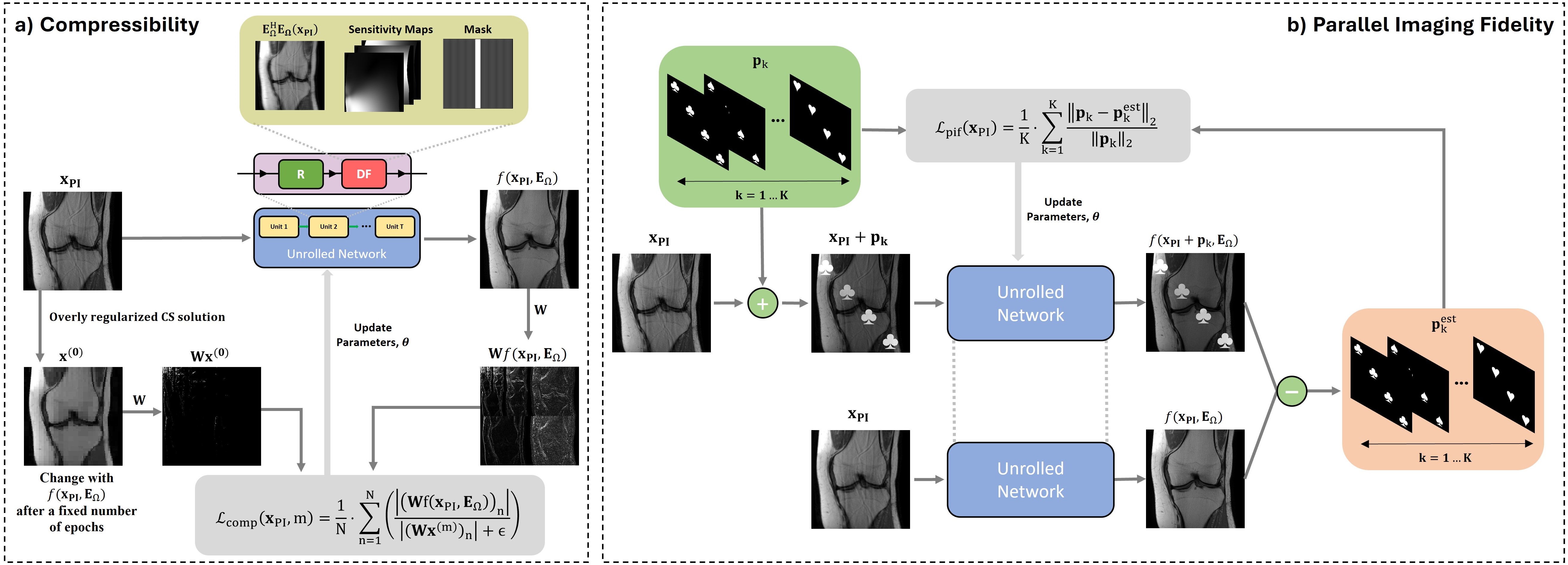
We propose CUPID, a physics-driven deep learning (PD-DL) method that trains fast MRI reconstruction models using only routine clinical images, without requiring raw k-space data. CUPID leverages compressibility-based quality measures and perturbation-driven consistency with clinical parallel imaging to enable high-quality reconstructions. Experiments show CUPID achieves quality comparable to k-space–based PD-DL methods and surpasses compressed sensing and diffusion approaches, while enabling zero-shot training for retrospective and prospective sub-sampling. By removing the need for raw data, CUPID broadens access to advanced MRI acceleration techniques, particularly for rural and underserved populations.
Fast MRI for All: Bridging Access Gaps by Training without Raw Data
Yasar Utku Alcalar, Merve Gulle, Mehmet Akcakaya
Neural Information Processing Systems (NeurIPS) 2025 Spotlight
We propose CUPID, a physics-driven deep learning (PD-DL) method that trains fast MRI reconstruction models using only routine clinical images, without requiring raw k-space data. CUPID leverages compressibility-based quality measures and perturbation-driven consistency with clinical parallel imaging to enable high-quality reconstructions. Experiments show CUPID achieves quality comparable to k-space–based PD-DL methods and surpasses compressed sensing and diffusion approaches, while enabling zero-shot training for retrospective and prospective sub-sampling. By removing the need for raw data, CUPID broadens access to advanced MRI acceleration techniques, particularly for rural and underserved populations.
Time-Embedded Algorithm Unrolling for Computational MRI
Junno Yun, Yasar Utku Alcalar, Mehmet Akcakaya
Neural Information Processing Systems (NeurIPS) 2025
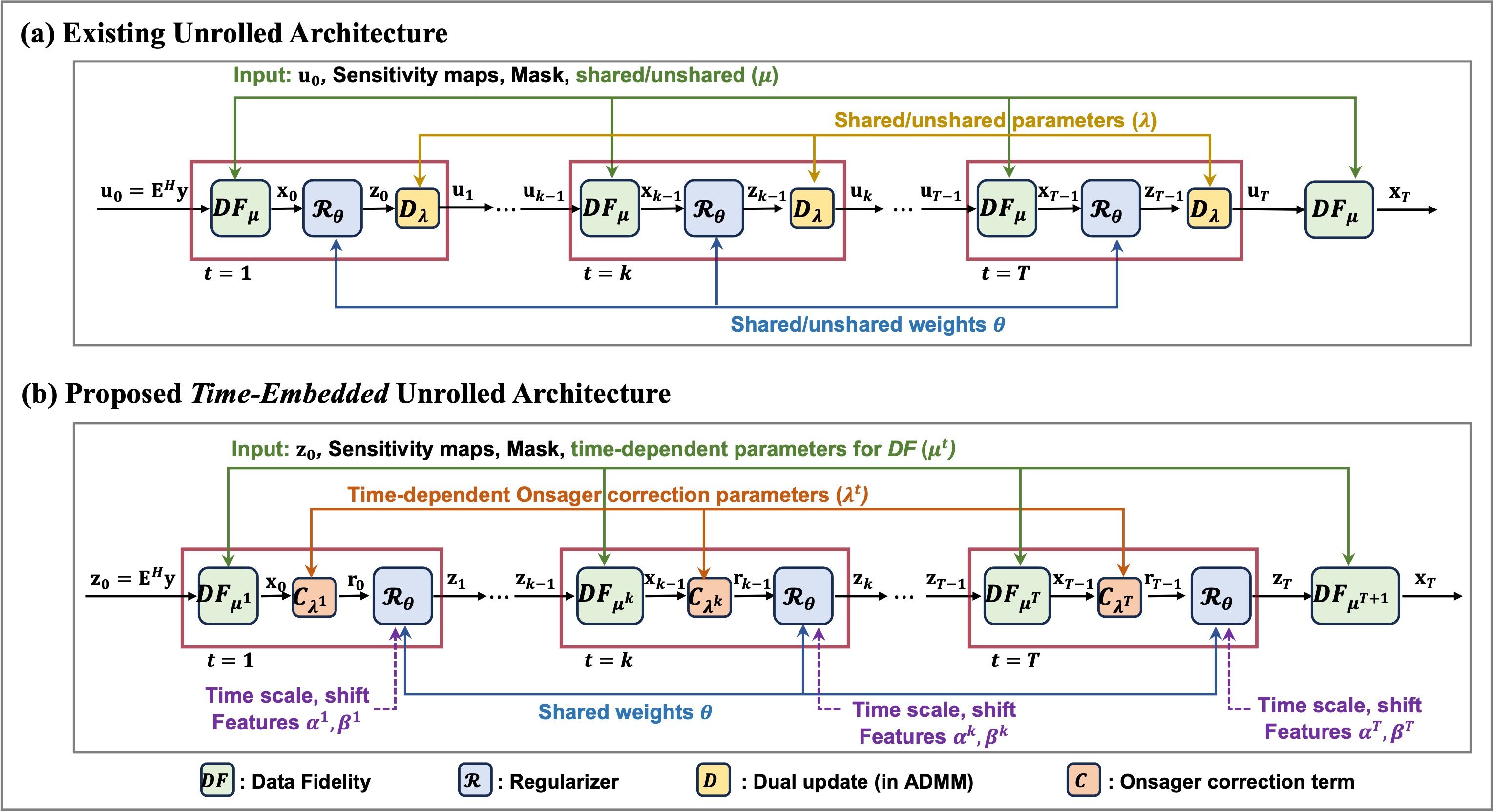
We propose a time-embedded algorithm unrolling framework for MRI reconstruction that integrates iteration-dependent proximal operations and data fidelity weights inspired by AMP and diffusion models. By embedding iteration indices into the proximal network and fidelity parameters, our method reduces artifacts and noise while avoiding parameter growth from using distinct networks. Experiments on the fastMRI dataset show state-of-the-art performance across acceleration rates, and the time-embedding strategy further enhances existing unrolling methods without added complexity.
Time-Embedded Algorithm Unrolling for Computational MRI
Junno Yun, Yasar Utku Alcalar, Mehmet Akcakaya
Neural Information Processing Systems (NeurIPS) 2025
We propose a time-embedded algorithm unrolling framework for MRI reconstruction that integrates iteration-dependent proximal operations and data fidelity weights inspired by AMP and diffusion models. By embedding iteration indices into the proximal network and fidelity parameters, our method reduces artifacts and noise while avoiding parameter growth from using distinct networks. Experiments on the fastMRI dataset show state-of-the-art performance across acceleration rates, and the time-embedding strategy further enhances existing unrolling methods without added complexity.
Sparsity-Driven Parallel Imaging Consistency for Improved Self-Supervised MRI Reconstruction
Yasar Utku Alcalar, Mehmet Akcakaya
International Conference on Image Processing (ICIP) 2025 Spotlight Oral
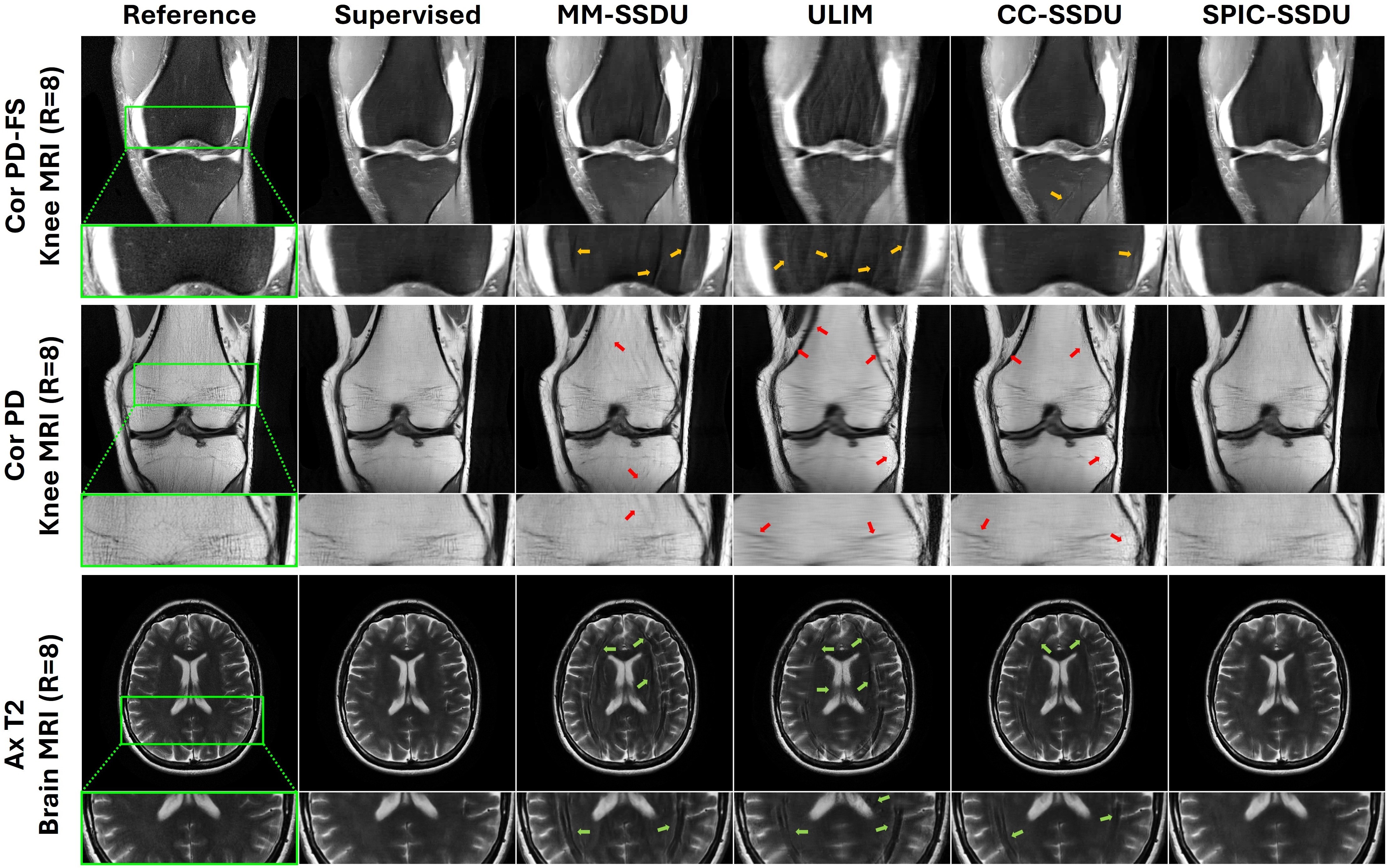
In this work, we introduce a physics-driven deep learning (PD-DL) approach for rapid MRI reconstruction without fully sampled reference data. Our method, SPIC-SSDU, enhances self-supervised training with perturbation-based consistency checks in sparse domains, extending conventional k-space masking with a novel term that evaluates the model’s ability to predict carefully designed additive perturbations. This improves robustness at high acceleration rates, reducing artifacts and noise. Tests on the fastMRI knee and brain datasets show improved image quality over existing self-supervised techniques, achieving performance comparable to supervised learning.
Sparsity-Driven Parallel Imaging Consistency for Improved Self-Supervised MRI Reconstruction
Yasar Utku Alcalar, Mehmet Akcakaya
International Conference on Image Processing (ICIP) 2025 Spotlight Oral
In this work, we introduce a physics-driven deep learning (PD-DL) approach for rapid MRI reconstruction without fully sampled reference data. Our method, SPIC-SSDU, enhances self-supervised training with perturbation-based consistency checks in sparse domains, extending conventional k-space masking with a novel term that evaluates the model’s ability to predict carefully designed additive perturbations. This improves robustness at high acceleration rates, reducing artifacts and noise. Tests on the fastMRI knee and brain datasets show improved image quality over existing self-supervised techniques, achieving performance comparable to supervised learning.
Zero-Shot Adaptation for Approximate Posterior Sampling of Diffusion Models in Inverse Problems
Yasar Utku Alcalar, Mehmet Akcakaya
European Conference on Computer Vision (ECCV) 2024
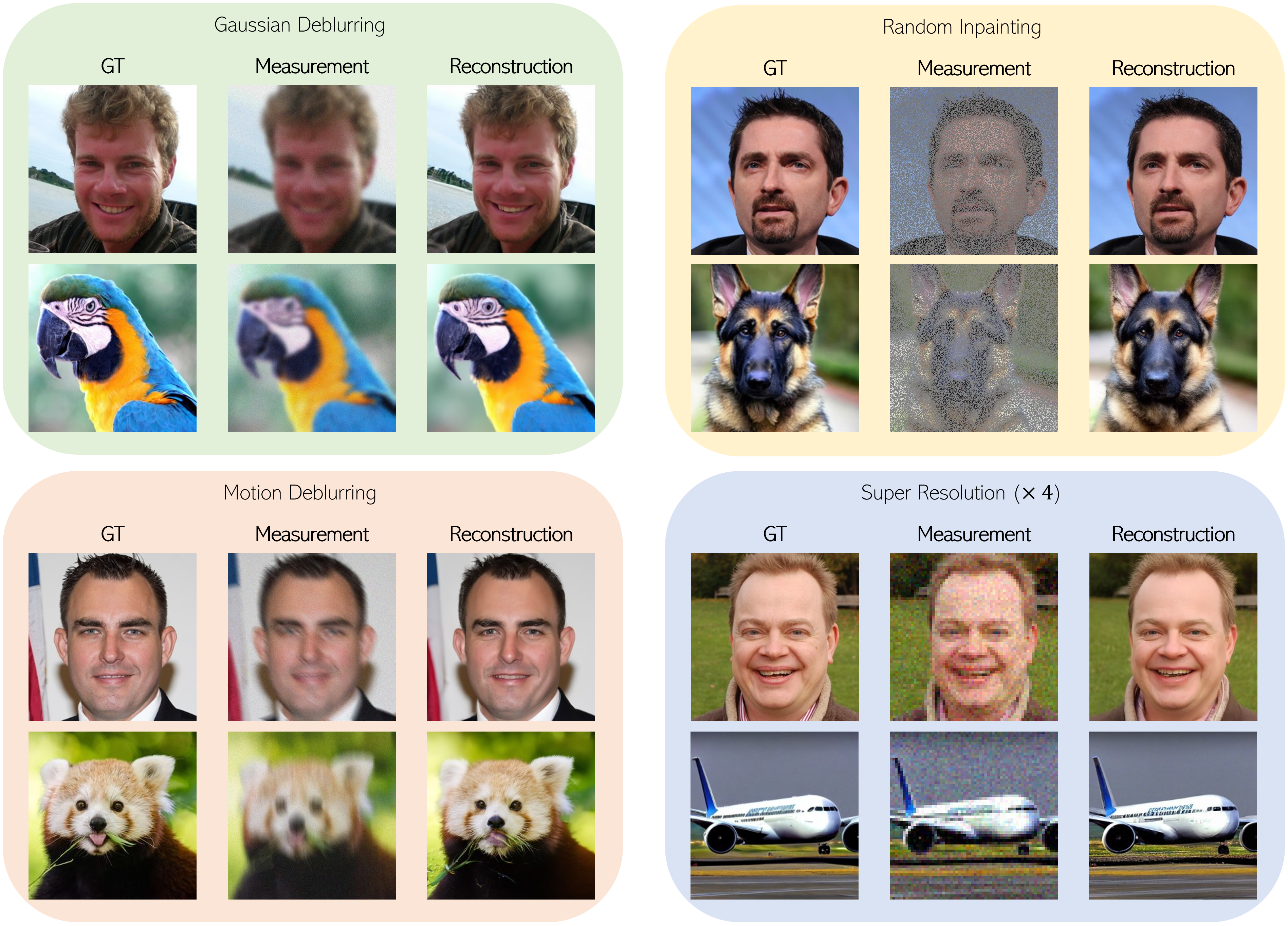
We introduce ZAPS (Zero-shot Approximate Posterior Sampling), a diffusion-based framework for solving inverse problems with faster inference and improved robustness. Unlike conventional diffusion models that rely on many steps and empirically tuned weights, ZAPS fixes the number of sampling steps and learns log-likelihood weights at each irregular timestep via a physics-guided zero-shot loss. To further reduce computational burden, we approximate the prior Hessian through a learnable diagonalization, enabling efficient training and inference without sacrificing accuracy. Applied to deblurring, inpainting, and super-resolution, ZAPS accelerates inference and improves reconstruction quality over diffusion posterior sampling baselines.
Zero-Shot Adaptation for Approximate Posterior Sampling of Diffusion Models in Inverse Problems
Yasar Utku Alcalar, Mehmet Akcakaya
European Conference on Computer Vision (ECCV) 2024
We introduce ZAPS (Zero-shot Approximate Posterior Sampling), a diffusion-based framework for solving inverse problems with faster inference and improved robustness. Unlike conventional diffusion models that rely on many steps and empirically tuned weights, ZAPS fixes the number of sampling steps and learns log-likelihood weights at each irregular timestep via a physics-guided zero-shot loss. To further reduce computational burden, we approximate the prior Hessian through a learnable diagonalization, enabling efficient training and inference without sacrificing accuracy. Applied to deblurring, inpainting, and super-resolution, ZAPS accelerates inference and improves reconstruction quality over diffusion posterior sampling baselines.